Warning on risks: Financial contracts for difference are complex instruments and are associated with a high risk of rapid financial losses due to leverage. On 77.44% of retail investor accounts, financial losses occur when trading financial contracts for difference with this provider. You should consider whether you understand how financial contracts for difference work, and whether you can afford to take the high risk of suffering financial losses. Please read the Risk Disclosures.

Accenture: Earnings Eased Concerns About AI, and Shares Rose 22%
Can Accenture profit from technology that may reduce the need for its own services? The rise of artificial intelligence raises questions about the future of the consulting business, and the company’s latest results give investors a new reason to pay attention. However, revenue and profit alone do not tell the whole story. Far more important are what client decisions and management expectations reveal. These may indicate whether Accenture is headed for a period of new opportunities or a more challenging future than it appears today. [1]
About the company
Accenture plc is a global consulting and technology company headquartered in Dublin, Ireland. It was founded in 1989 as Andersen Consulting and has operated under its current name, Accenture, since 2001. It helps businesses and public institutions modernize their information systems, implement artificial intelligence, strengthen cybersecurity, and streamline business processes. At the end of fiscal year 2026, it employed approximately 814,000 people and reported annual revenue of $74.2 billion. It provides services to approximately 9,000 clients in more than 120 countries, and its shares are traded on the New York Stock Exchange under the ticker symbol ACN.1
Results that shifted investor sentiment
On October 1, 2026, Accenture reported results for the fourth quarter of fiscal year 2026, which ended on August 31. Revenue reached $18.68 billion, up 6% year-over-year in dollar terms, or 7% after adjusting for currency effects. This exceeded analysts’ average expectations of $18.03 billion. New orders totaled $22.17 billion, representing a 4% year-over-year increase. However, this figure should not be confused with revenue already reported, as orders may be fulfilled over multiple periods. Investors responded with strong buying interest, and the stock rose by approximately 22% during trading.* This reaction came after a period in which the company’s stock had lost about one-third of its value since the beginning of the year. The results, along with the new outlook, alleviated concerns that the spread of artificial intelligence would significantly limit demand for consulting and technology services.2
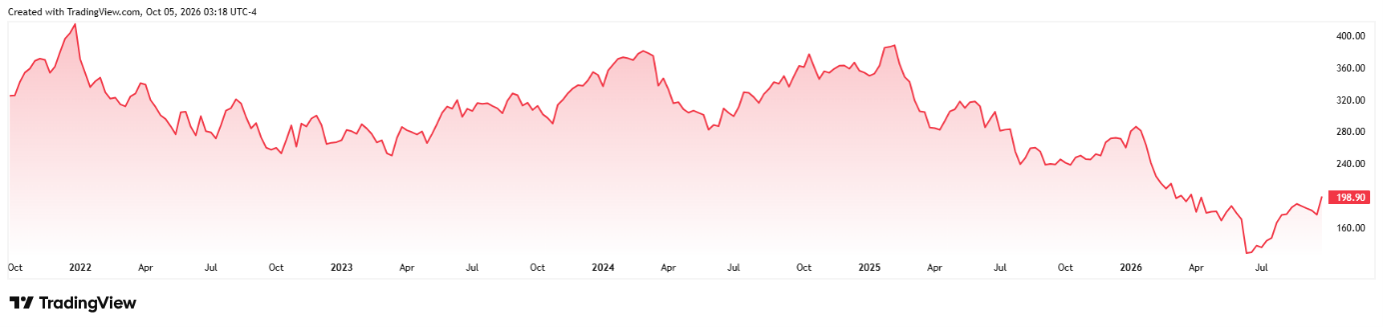
Accenture’s stock price performance over the past five years*
The 46% profit growth needs explanation
Reported earnings per share reached $3.29, compared to $2.25 a year ago, representing a 46% increase. However, this pace cannot automatically be attributed to a sharp improvement in business performance. Last year’s results were reduced by reorganization costs, primarily severance pay, totaling approximately $615 million before taxes. Excluding these costs, earnings per share at that time were $3.03, so the current increase represents approximately 9% compared to this adjusted figure. A similar difference can be seen in the operating margin. It reached 15.3%, whereas a year ago it was reported at 11.6% and, after adjusting for the aforementioned costs, stood at 15.1%. Accenture has thus improved its profitability, but a significant portion of the reported growth is due to the fact that last year’s costs were not repeated this quarter. To evaluate the results, it is therefore more important to look at the adjusted comparison, not just the most striking percentage.2
AI brings new business and changes to compensation
Data on clients and partnerships provide a more concrete picture of the role of artificial intelligence. During fiscal year 2026, more than 400 clients launched their first advanced AI projects with Accenture. The value of orders related to eight emerging partners in the AI and data space more than tripled year-over-year, and the corresponding revenue more than doubled. However, these figures pertain to a specific group of partners, not all of the company’s AI revenue. A significant change is also taking place in how services are billed. More than 65% of the order volume now consists of fixed-price work, which also includes contracts paid based on results achieved. This model can reduce the dependence of revenue on the number of hours worked and allow the company to retain a portion of the savings achieved through automation. At the same time, however, it increases the importance of accurate cost estimates and the ability to meet agreed-upon terms. Completing work more quickly can therefore support profitability, but does not guarantee it on its own.3[2]
Shareholders received a record $11.5 billion
The company’s financial strength is underpinned by its ability to convert results into cash. For fiscal year 2026, Accenture generated free cash flow of approximately $11.6 billion, a 7% increase year-over-year. At the same time, it returned a record $11.5 billion to shareholders through dividends and share buybacks, representing a 38% increase. The company thus paid out to investors an amount nearly equal to its full-year free cash flow. In fiscal year 2027, it plans to return at least $9.5 billion, with approximately $5.5 billion to come from share buybacks. It also announced a 5% increase in its quarterly dividend to $1.71 per share. Management also expects the average number of shares to decline by approximately 3% in fiscal year 2027. This could support earnings per share growth even without equally rapid growth in total earnings. However, buybacks alone do not replace growth in demand for services.2, 4[3]
The outlook is encouraging, but part of the growth will come from acquisitions
Accenture expects revenue growth of 3 to 6% in fiscal year 2027, adjusted for currency effects, and earnings per share in the range of $14.39 to $14.81. The midpoint of the revenue growth outlook, at 4.5%, exceeded analysts’ average expectation of 3.9%. However, the more favorable outlook does not mean that all growth will come from existing operations. According to the company, acquisitions are expected to contribute approximately 2 to 2.5 percentage points, so it will be important to also monitor growth excluding their impact. The company also noted that it faced lower prices in many areas during the quarter. This is because clients are demanding that a portion of the savings from using AI be passed on to them in the form of lower costs. For investors, the key question remains whether new projects and increased efficiency can offset pricing pressure over the long term. The results support a more favorable view of Accenture, but they do not yet resolve the question of long-term profitability in the era of artificial intelligence.2, 3[4]
Conclusion
With its results, Accenture has indicated that artificial intelligence does not necessarily spell the decline of consulting and technology firms. New quarterly orders worth $22.17 billion and free cash flow of $11.6 billion for fiscal year 2026 confirm both the demand for its services and the financial capacity for further growth. However, the outlook for revenue growth of 3 to 6% in fiscal year 2027, adjusted for currency effects, also suggests that the company expects gradual growth rather than a sharp acceleration. Therefore, what will be decisive is not only winning new projects but also the ability to turn them into profit and retain a portion of the savings achieved through automation. If Accenture can grow its existing business, successfully integrate acquisitions, and protect its margins, it can strengthen its position in the adoption of AI in business. The latest results provide grounds for more optimistic expectations, but no guarantee that they will be met. The company’s long-term value will depend on whether it can consistently profit from technological change, rather than merely helping clients adapt to it. [5]
Sources
Accenture – Fourth-quarter fiscal 2026 earnings release (PDF)
Accenture – Fourth-quarter fiscal 2026 earnings presentation (PDF)
* Past performance is no guarantee of future results.
[1,2,3,4,5] Forward-looking statements are based on assumptions and current expectations, which may be inaccurate, or on the current economic environment, which is subject to change. Such statements are not guarantees of future performance. They involve risks and other uncertainties that are difficult to predict. Actual results may differ materially from those expressed or implied in any forward-looking statements.
O.Z.I. Online Zone Investment Opportunities (OZIOS) is a registered trademark of APME FX TRADING EUROPE LTD, a Cyprus Investment Firm (CIF) supervised and regulated by the Cyprus Securities and Exchange Commission (CySEC) under CIF license number 335/17, with a registered address at Lophitis Business Center, Office 404, 4th Floor, 28 October Ave 249, Limassol 3035, Cyprus. Contracts for Difference (CFDs) are complex instruments and carry a high risk of rapid financial loss due to leverage. 77.44% of retail investor accounts lose money when trading CFDs with this provider. You should consider whether you understand how CFDs work and whether you can afford to take the high risk of losing your money.