Warning on risks: Financial contracts for difference are complex instruments and are associated with a high risk of rapid financial losses due to leverage. On 77.44% of retail investor accounts, financial losses occur when trading financial contracts for difference with this provider. You should consider whether you understand how financial contracts for difference work, and whether you can afford to take the high risk of suffering financial losses. Please read the Risk Disclosures.

BHP Group: Profits Jumped 30%, and Copper Surpassed Iron Ore for the First Time
The results from one of the world’s largest mining companies show that the balance of power in the global industry is beginning to shift. What has long been a stable pillar of its business is now taking a back seat, replaced by a commodity that could fundamentally influence the future development of the entire sector. Investors are thus watching not only the strong numbers but also a quiet shift that could redefine the company’s direction for an entire decade. [1]
About the company
BHP Group Limited is an Australian multinational mining company headquartered in Melbourne. The company was founded in 1885 as the Broken Hill Proprietary Company, and its history began with the mining of silver, lead, and zinc in the Broken Hill region of the Australian state of New South Wales. Today, BHP is one of the largest mining companies in the world, and its operations focus primarily on the production of copper, iron ore, coking coal, and potash. The company employs more than 80,000 people, including contractors, and produced approximately 2 million metric tons of copper in fiscal year 2026.[1]
Results significantly exceeded last year’s
BHP Group ended fiscal year 2026 in significantly better shape than a year ago. The company’s revenue rose 15% to $58.8 billion, while operating profit reached $23.9 billion, up 23% year-over-year. Adjusted EBITDA rose even more sharply, by 27%, to $32.9 billion, and the EBITDA margin improved from 53% to 59%. Net income attributable to shareholders reached $9.8 billion, representing a 9% year-over-year increase, but the result was even stronger after adjusting for extraordinary items. Adjusted net income attributable to shareholders jumped 30% to $13.2 billion, exceeding the analyst consensus of $12.66 billion. Higher realized prices for copper, iron ore, and coking coal, along with strong operational performance and cost control, were the main drivers of this growth. Investors reacted positively, and BHP shares rose as much as 4.2% following the earnings release to a two-month high of AUD 64.79.*1[2]
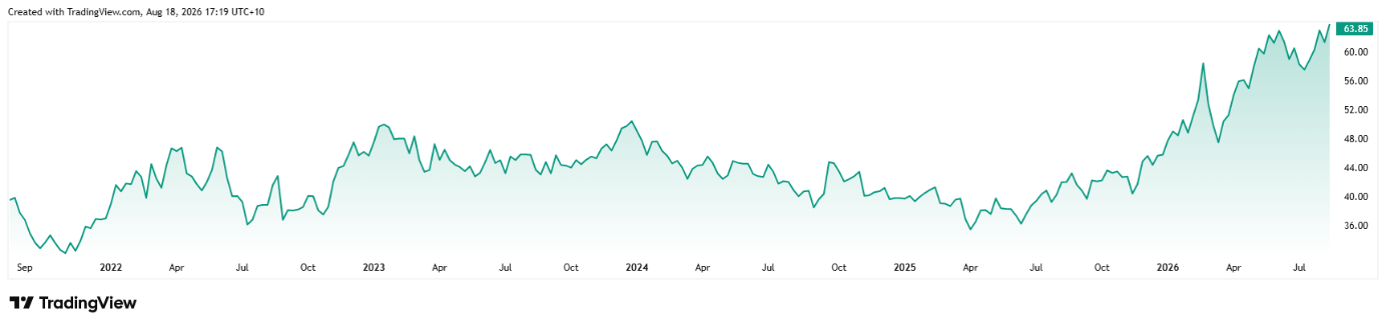
BHP Group Share Price Performance Over the Past Five Years*
Copper is definitely taking the lead
However, the most significant takeaway from the earnings report is not the profit growth itself, but the marked shift in where BHP is generating its profits. The copper segment generated adjusted EBITDA exceeding $18 billion and, for the first time, accounted for 54% of the group’s total adjusted EBITDA. The segment’s EBITDA margin reached an exceptionally high 70%, and the copper segment alone generated approximately $6.9 billion in free cash flow. Operating profit from copper, including by-products such as gold and uranium, reached $18.19 billion, definitively surpassing the $14.53 billion attributable to iron ore. This marks a significant turning point for BHP, as iron ore had long been the main driver of the company’s performance. At the same time, BHP produced approximately 2 million metric tons of copper for the second consecutive year, solidifying its position as one of the world’s largest producers of this metal. Copper’s importance is also growing thanks to its record prices, which rose above $14,000 per metric ton during the year due to rising demand from power grids, data centers, and other energy infrastructure.1[3]
Iron ore remains a strong pillar
Although copper has taken the lead in BHP’s profitability, iron ore remains an extremely important source of cash for the company. Western Australia Iron Ore’s operations achieved record production of 291.2 million metric tons of iron ore in the fiscal year, surpassing the approximately 290 million metric tons produced the previous year. At the same time, the average realized price of iron ore rose by 3% to $84.56 per wet metric ton. Operating profit for the Australian iron ore segment subsequently reached $14.67 billion, up 2% year-over-year, coming very close to the analyst consensus of $14.75 billion. BHP expects to produce 286 to 298 million metric tons in Western Australia in fiscal year 2027 and is also preparing a new project, Ministers North, which is intended to help maintain the entire complex’s production above 305 million metric tons per year in the long term. The biggest risk remains the trend in Chinese demand for steel and more complicated negotiations with Chinese buyers, as China remains a key customer for the global iron ore market.1[4] [2]
Cash flow is growing, and debt is falling sharply
Strong commodity prices were also reflected in BHP’s ability to generate cash. Operating cash flow rose by 17% from $18.7 billion to $21.8 billion, and free cash flow jumped by as much as 83% from $5.3 billion to $9.8 billion. At the same time, the company increased its capital and exploration expenditure by 5% to $10.3 billion, with investments in copper alone reaching $4.7 billion. Strong cash generation and active capital management enabled BHP to reduce its net debt from $12.9 billion to $8.7 billion, and the debt-to-equity ratio fell from 19.8% to 13.4%. This gives management significantly more leeway to finance new projects and reward shareholders. The result is a final dividend of $0.99 per share, which brought the full-year dividend to $1.72 per share, the highest annual payout in the last four years. Total announced cash returns to shareholders for the year reached $8.7 billion.1
BHP is building its future on copper
The results also showed that copper’s current success is not merely a short-term consequence of high prices for BHP. The company has an extensive pipeline of projects in Chile, Australia, and Argentina that could increase copper production by approximately 40% by fiscal year 2035. At Escondida, the world’s largest copper mine, BHP has already approved $500 million for preparatory work on a new concentrator ahead of the expected final investment decision in 2027–2028. The company is also developing Copper South Australia and the Vicuña project on the border between Argentina and Chile. Management expects global demand for copper to rise from the current level of approximately 34 million metric tons per year to more than 50 million metric tons by 2050. However, BHP will not be investing solely in copper. The first phase of the massive Jansen potash mining project in Canada is 84% complete, and initial production is expected in mid-2027. Capital and exploration expenditures are projected to reach approximately $11 billion in fiscal year 2027, and the company expects similar levels in subsequent years. BHP is thus gradually transforming from a company predominantly reliant on iron ore into a more diversified producer of raw materials, with its growth increasingly driven by copper and other commodities needed for the expanding energy and food infrastructure.1[5] [3]
Conclusion
Today, BHP Group stands at a point where its future growth is increasingly less reliant on iron ore alone and is shifting more significantly toward copper and other strategic raw materials. Fiscal year 2026 brought a 30% increase in adjusted earnings to $13.2 billion, free cash flow of $9.8 billion, and a historic moment when copper surpassed iron ore for the first time as the company’s largest source of profitability. It is precisely the growing importance of copper, ongoing investments in new projects, and the expected long-term growth in global demand that are creating new opportunities for BHP to expand. At the same time, the company remains one of the world’s largest iron ore producers and maintains a strong balance sheet, which enables it to finance further growth and reward shareholders through dividends. If BHP succeeds in increasing copper production as planned while maintaining high efficiency in its existing operations, the current record results may not represent the peak of the cycle, but rather the beginning of a more significant transformation of one of the world’s largest mining companies. [4]
[1,2,3,4] Forward-looking statements are based on assumptions and current expectations, which may be inaccurate, or on the current economic environment, which may change. Such statements are not guarantees of future performance. They involve risks and other uncertainties that are difficult to predict. Actual results may differ materially from those expressed or implied in any forward-looking statements.
* Past performance is no guarantee of future returns.
O.Z.I. Online Zone Investment Opportunities (OZIOS) is a registered trademark of APME FX TRADING EUROPE LTD, a Cyprus Investment Firm (CIF) supervised and regulated by the Cyprus Securities and Exchange Commission (CySEC) under CIF license number 335/17, with a registered address at Lophitis Business Center, Office 404, 4th Floor, 28 October Ave 249, Limassol 3035, Cyprus. Contracts for difference (CFDs) are complex instruments and carry a high risk of rapid financial loss due to leverage. 77.44% of retail investor accounts lose money when trading CFDs with this provider. You should consider whether you understand how CFDs work and whether you can afford to take the high risk of losing your money.
[1] https://www.bhp.com/-/media/documents/investors/annual-reports/2026/260818_bhpannualreport2026
[2] https://www.reuters.com/business/energy/bhp-profit-tops-estimates-copper-powers-growth-highest-dividend-4-years-2026-08-17/
[3] https://www.bhp.com/-/media/documents/media/reports-and-presentations/2026/260818_bhpresultsfortheyearended30june2026_presentation.pdf
[4] https://www.reuters.com/business/energy/bhp-misses-quarterly-copper-output-estimates-flags-lower-chilean-production-2026-07-15/
[5] https://www.bhp.com/-/media/documents/media/reports-and-presentations/2026/260818_bhpresultsfortheyearended30june2026_exchangerelease.pdf