Warning on risks: Financial contracts for difference are complex instruments and are associated with a high risk of rapid financial losses due to leverage. On 71.07% of retail investor accounts, financial losses occur when trading financial contracts for difference with this provider. You should consider whether you understand how financial contracts for difference work, and whether you can afford to take the high risk of suffering financial losses. Please read the Risk Disclosures.

Cisco: Record $18.5 billion in revenue for a single quarter
On November 12, Cisco announced that revenue for the first quarter of fiscal year 2027 rose 24% year-over-year to a record $18.5 billion. The company raised its full-year revenue outlook, but its stock fell 6.24% to $95.64 on the following trading day.* Can Cisco turn the growing demand for AI network infrastructure into higher long-term profitability?
About the company
Cisco Systems is an American publicly traded technology company headquartered in San Jose, California. It was founded in 1984 by Leonard Bosack and Sandy Lerner. Cisco supplies routers, network switches, and technologies for connecting data centers. It also offers cybersecurity products and tools for online collaboration and IT system monitoring. In fiscal year 2026, the company reported revenue of $63.3 billion, of which approximately 55% came from networking products. At the end of that period, it employed approximately 82,400 people. Its shares are traded on the Nasdaq under the symbol CSCO.
Record results were accompanied by a decline in Cisco’s stock price
In the first quarter of fiscal year 2027, which ended on October 24, 2026, Cisco increased revenue from $14.88 billion to a record $18.52 billion. Net income rose 59% to $4.55 billion, and diluted earnings per share increased from $0.72 to $1.14. Adjusted earnings per share reached $1.40, up 40% year-over-year. According to the company, this marked the fastest growth in revenue and adjusted earnings per share in more than 15 years. Cisco released its results on November 12 after the market closed. In the following regular trading session, the stock fell from $102.01 to $95.64, a decline of 6.24%.*
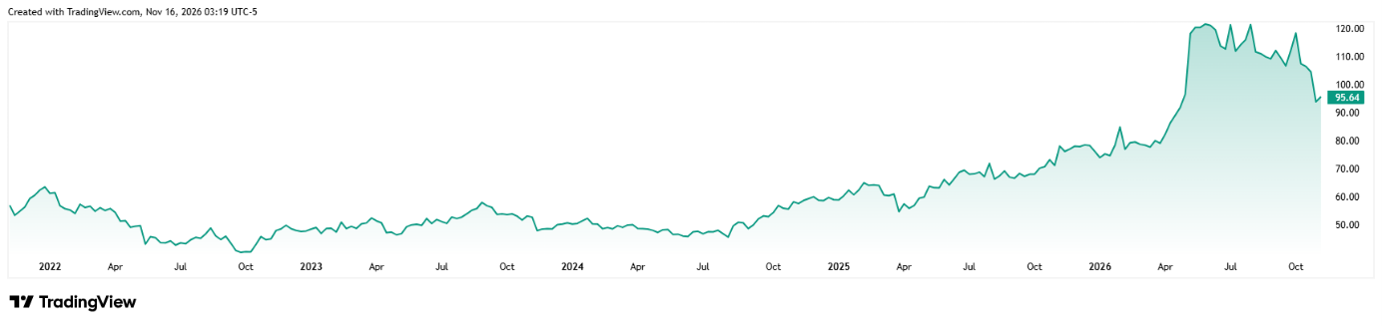
Cisco’s stock price performance over the past five years*
Networking products accounted for 60% of revenue
Networking products contributed the most to growth, with revenue rising 43% year-over-year to $11.13 billion. They accounted for approximately 60% of the company’s total revenue. Cisco reported sales growth in artificial intelligence infrastructure, data center switches, and enterprise networking equipment. Orders for networking products increased by 28%, marking the ninth consecutive quarter of double-digit growth. Total product orders rose by 21%. Excluding its largest cloud customers, growth reached 14%, indicating that higher demand was evident even outside this group. Cybersecurity revenue increased by 7% to $2.12 billion, while services revenue rose by 1% to $3.85 billion.
Cisco expects $9 billion from AI infrastructure
Cisco raised its revenue forecast for AI infrastructure for the largest cloud providers from $7.5 billion to $9 billion for fiscal year 2027. In the previous fiscal year, the company reported approximately $4 billion in revenue in this segment and received orders totaling $9.3 billion. The difference between these figures is significant. Orders reflect demand for deliveries, while revenue is recognized based on when Cisco fulfills the relevant contractual obligations. The company also announced that customers selected its technologies for three new AI projects in the past quarter. Two involve Silicon One P200 systems for interconnecting data centers, and the third involves optical components with a transmission speed of 1.6 terabits per second. [1]
Higher-priced memory reduced product margins
Cisco’s adjusted gross margin fell year-over-year from 68.1% to 65.6%, as hardware revenue grew faster than revenue from software and services. Higher prices for memory components also contributed to a decline in the adjusted gross margin for products from 67.2% to 63.7%. Meanwhile, the adjusted operating margin increased from 34.4% to a record 37.8%. These metrics reflect different costs. The gross margin accounts for the cost of products and services sold, while the operating margin also includes the company’s other expenses. Adjusted operating expenses rose by only 2%, while revenue increased by 24%. Operating expenses thus accounted for a smaller portion of revenue, and their slower growth more than offset the decline in gross margin.4
Higher full-year outlook anticipates further profit growth
Cisco raised its revenue outlook for fiscal year 2027 from a range of $72.2 billion to $73.4 billion to $74.8 billion to $75.8 billion. The midpoint of the new range is $2.5 billion higher than in the August outlook. The adjusted earnings per share estimate has shifted from a range of $5.05 to $5.11 to $5.47 to $5.53. For the second fiscal quarter, the company expects revenue of $18 to $18.2 billion and adjusted earnings per share of $1.34 to $1.36. The outlook for the adjusted operating margin, at 36 to 37 percent, is below the record 37.8 percent set in the first quarter. The higher full-year estimate therefore does not anticipate that Cisco will repeat its record operating margin as early as the next quarter.3 [2]
Conclusion
Cisco has posted a record quarter, in which revenue growth was driven primarily by sales of networking products. The upward revision of the revenue outlook for artificial intelligence infrastructure to $9 billion underscores the importance management attaches to this area. However, a higher proportion of hardware in sales and more expensive memory components put downward pressure on the adjusted gross margin. Nevertheless, the adjusted operating margin reached a record 37.8%, as operating expenses grew more slowly than revenue. For investors, it will therefore be crucial in the coming quarters to see whether Cisco can meet its higher outlook and maintain profit growth even amid pressure on hardware margins. [3]
* Past performance is no guarantee of future results.
[1,2,3] Forward-looking statements are based on assumptions and current expectations, which may be inaccurate, or on the current economic environment, which may change. Such statements are not guarantees of future performance. They involve risks and other uncertainties that are difficult to predict. Actual results may differ materially from those expressed or implied in any forward-looking statements.
O.Z.I. Online Zone Investment Opportunities (OZIOS) is a registered trademark of APME FX TRADING EUROPE LTD, a Cyprus Investment Firm (CIF) supervised and regulated by the Cyprus Securities and Exchange Commission (CySEC) under CIF license number 335/17, with a registered address at Lophitis Business Center, Office 404, 4th Floor, 28 October Ave 249, Limassol 3035, Cyprus. Contracts for Difference (CFDs) are complex instruments and carry a high risk of rapid financial loss due to leverage. 71.07% of retail investor accounts lose money when trading CFDs with this provider. You should consider whether you understand how CFDs work and whether you can afford to take the high risk of losing your money.
[1] https://en.wikipedia.org/wiki/Cisco
[2] https://www.cisco.com/c/dam/en_us/about/annual-report/2026-cisco-full-annual-report.pdf
[3] https://investor.cisco.com/news/news-details/2026/CISCO-REPORTS-FIRST-QUARTER-EARNINGS/default.aspx
[4] https://s21.q4cdn.com/812015656/files/doc_earnings/2027/q1/presentation/Q1-27-Earnings-Slides.pdf