Warning on risks: Financial contracts for difference are complex instruments and are associated with a high risk of rapid financial losses due to leverage. On 77.44% of retail investor accounts, financial losses occur when trading financial contracts for difference with this provider. You should consider whether you understand how financial contracts for difference work, and whether you can afford to take the high risk of suffering financial losses. Please read the Risk Disclosures.

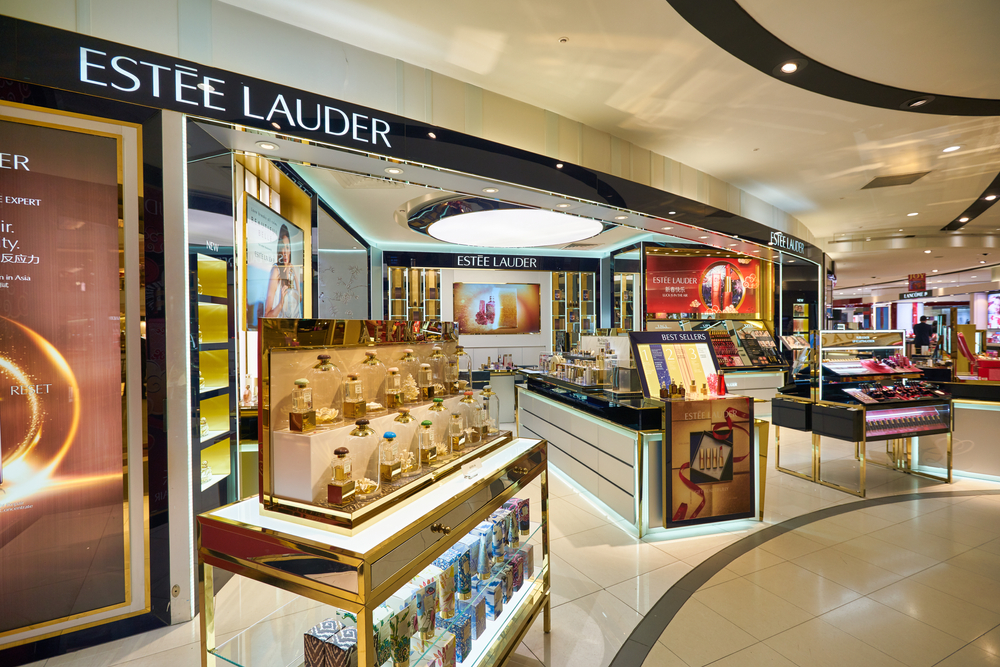
Estée Lauder and Puig Could Shift the Balance of Power in the Beauty Industry
At the end of March, the cosmetics and fragrance world received news that may rank among the most significant corporate events of the year. Estée Lauder and Madrid-based Puig confirmed merger talks, with the potential transaction creating a group with a combined market value of approximately $40 billion. At a time of weaker consumer demand and growing pressure for efficiency, this is a development that goes beyond a single company and raises the question of whether a new wave of consolidation is beginning in the global beauty sector.[1]
About the Company
Estée Lauder Companies is an American company operating in the cosmetics, skincare, fragrance, and makeup sectors. Founded in 1946, it has grown over the decades to become one of the biggest names in the global beauty industry, with a portfolio built on strong premium brands and global distribution. Puig is a Spanish company headquartered in Barcelona, with a history dating back to 1914, that has long been building its position in perfumes, fashion, and luxury cosmetics.[2][3]
A merger that would create a $40 billion beauty group
Negotiations between Estée Lauder and Puig are among the biggest corporate surprises of late March, as a potential transaction would create a luxury beauty group with a combined market capitalization of around $40 billion. Puig shares jumped 13% after the talks were confirmed and were on track for the best trading day in the company’s history, while Estée Lauder shares have fallen by more than 23% since the announcement.* The market reaction alone shows that investors do not view this news as mere corporate speculation, but as an event that could fundamentally shift the balance of power in the global beauty sector. At stake is not just the merger of two well-known names, but the emergence of a player that could significantly strengthen its position, particularly in perfumes, while also being substantially larger, more diversified, and more competitive against its biggest rivals.1
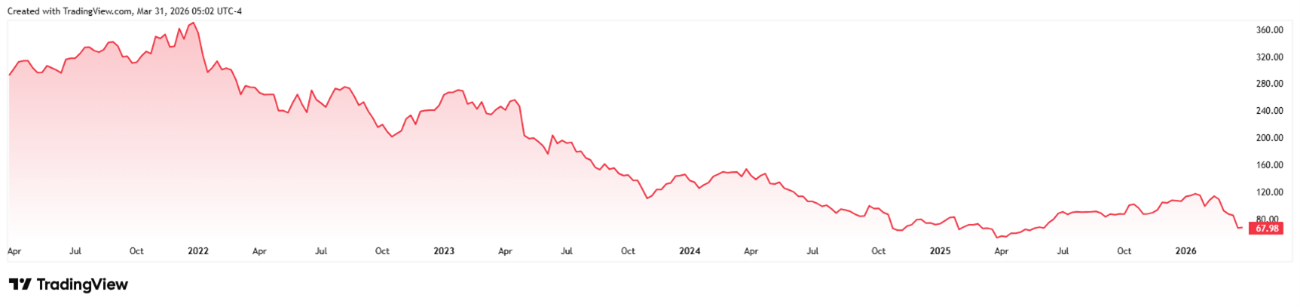
Estee Lauder’s stock price performance over the past five years*
Estée Lauder Seeks a New Path to Growth
For Estée Lauder, these negotiations come at a very sensitive time, as the company is striving to halt three years of declining annual sales and restore growth under the leadership of CEO Stéphane de La Faverie. The company expects full-year net sales growth of 3% to 5% and adjusted earnings per share in the range of $2.05 to $2.25, with the second fiscal quarter bringing in $4.23 billion in revenue and adjusted earnings of $0.89 per share.[1] The company is also continuing its restructuring, which, according to other reports, has already resulted in 6,000 job cuts and a total net reduction of up to 7,000 positions, indicating that the turnaround is not yet complete and requires further action. This is precisely why interest in Puig appears as a strategic shortcut to growth, one that could help Estée Lauder strengthen its position in areas where demand is more resilient and margins are more attractive than in traditional cosmetics.[4]
Fragrances are the most valuable part of the story today
The key to the entire transaction is the fragrance segment, because that is where Puig has an exceptionally strong position and where Estée Lauder wants to gain greater traction. More than 70% of Puig’s revenue comes from its fragrance lines, and the Carolina Herrera, Rabanne, and Jean Paul Gaultier brands each generate close to $1 billion in revenue, making them globally recognizable and highly monetizable assets. Morningstar estimates that following the merger, Estée Lauder’s share of the premium fragrance market would rise to 15% from 6%, bringing the company very close to L’Oréal, which holds approximately 16%. In an environment where premium perfumes in the U.S. grew by 5% in value last year,* this is a logical attempt to shift the portfolio’s focus to a category that continues to grow faster than many other segments of the beauty market.1[5]
The size of the deal also brings significant risks
Although the strategic logic behind the merger is clear, the market very quickly began to question whether such a deal is financially and managerially feasible. A potential transaction financed equally by debt and equity could require Estée Lauder to take on approximately $6 billion in new debt, which, according to JPMorgan, could push the company’s debt-to-equity ratio to 4.3x even before accounting for synergies. Furthermore, both Moody’s and S&P Global have a negative outlook on the company, meaning the market already views its financial profile more cautiously than in the past. Analysts also point out that integrating such a large acquisition could distract management at a time when Estée Lauder needs exactly the opposite approach—namely, strict discipline in investing in brands, innovation, distribution, and performance in individual markets.5
The battle with L'Oréal is entering a new phase
If the negotiations were to result in an actual agreement, it would not merely be an internal matter between two companies, but a complete redrawing of the competitive landscape of the entire luxury beauty segment. The combined revenue of the merged business would exceed €20 billion, which would be more than the €15.6 billion generated by L'Oréal's Luxe division, which sells brands such as Armani and Yves Saint Laurent. [1] The situation is all the more significant given that L’Oréal already acquired Kering’s beauty assets for $4.7 billion last October and increased its perfume sales by 10.4% in 2025, roughly double the pace of the broader market. This is precisely why the negotiations between Estée Lauder and Puig can be interpreted as both a defensive and an offensive move, with one group seeking to stabilize its revenue and the other aiming to gain greater leverage in the battle for the most profitable segment of the global beauty market.15
Conclusion
The negotiations between Estée Lauder and Puig show that the global beauty sector is no longer just about the organic growth of individual brands, but increasingly also about the battle for scale, portfolio strength, and positioning in the most profitable categories. A potential merger would create a group with a market value of around $40 billion and significantly strengthen Estée Lauder’s position in perfumes, where its share in the premium segment could rise to 15% from 6%, according to estimates. At the same time, however, this is a move that comes amid Estée Lauder’s ongoing restructuring, pressure to grow, and a more sensitive market view of debt, so the outcome of this effort will depend not only on the size of the deal but also on management’s ability to translate strategic logic into real revenue growth, profitability, and competitiveness.
* Past performance is no guarantee of future results
[1] Forward-looking statements are based on assumptions and current expectations that may prove to be inaccurate, or on the current economic environment, which may change. Such statements are not guarantees of future performance. They involve risks and other uncertainties that are difficult to predict. Results may differ materially from those expressed or implied in any forward-looking statements.
O.Z.I. Online Zone Investment Opportunities (OZIOS) is a registered trademark of APME FX TRADING EUROPE LTD, a Cyprus Investment Firm (CIF) supervised and regulated by the Cyprus Securities and Exchange Commission (CySEC) under CIF license number 335/17, with a registered address at Lophitis Business Center, Office 404, 4th Floor, 28 October Ave 249, Limassol 3035, Cyprus. Contracts for difference (CFDs) are complex instruments and come with a high risk of rapid financial loss due to leverage. 76.44% of retail investor accounts lose money when trading CFDs with this provider. You should consider whether you understand how CFDs work and whether you can afford to take the high risk of losing your money.
[1]https://www.reuters.com/business/spains-puig-shares-jump-after-it-confirms-merger-talks-with-estee-lauder-2026-03-24/
[2]https://en.wikipedia.org/wiki/The_Est%C3%A9e_Lauder_Companies
[3]https://en.wikipedia.org/wiki/Puig_ (company)
[4]https://www.reuters.com/business/retail-consumer/estee-lauder-raises-annual-sales-forecast-2026-02-05/
[5]https://www.reuters.com/business/estee-lauders-bet-puig-is-bold-fragrance-play-volatile-world-2026-03-24/