Warning on risks: Financial contracts for difference are complex instruments and are associated with a high risk of rapid financial losses due to leverage. On 77.44% of retail investor accounts, financial losses occur when trading financial contracts for difference with this provider. You should consider whether you understand how financial contracts for difference work, and whether you can afford to take the high risk of suffering financial losses. Please read the Risk Disclosures.

Intel: Back in the AI Spotlight and Driving a New Wave of Growth
Stock markets took notice last week after Intel, on April 24, 2026, boosted the entire semiconductor sector and helped push U.S. chip stocks to record highs. Investors began to view the company as a much more serious contender for a return to the big leagues, as the stronger outlook suggested that the restructuring might not remain merely on paper but could translate into real results and a better position in the AI cycle.
About the company
Intel Corporation is an American technology company founded in 1968 by Robert Noyce and Gordon Moore. Headquartered in Santa Clara, California, the company introduced the Intel 4004 processor in 1971, which was among the first commercially available microprocessors. After more than 50 years in business, Intel is one of the most prominent names in the semiconductor industry and today focuses on processors for personal computers, servers, and data centers, as well as on strengthening its position in AI and advanced chip manufacturing.[1]
Results that shifted market sentiment
On April 23, 2026, Intel surprised investors by releasing a second-quarter revenue outlook that exceeded Wall Street estimates, and immediately following the results, shares jumped 19%*. The company beat market expectations in the first quarter, which was particularly significant because, prior to the results, analysts had anticipated a year-over-year revenue decline of 1.9% to $12.42 billion and a nearly 90% drop in adjusted earnings per share. It was precisely the contrast between low expectations and stronger results that caused Intel to shift overnight from the category of troubled stocks to the center of the entire market’s attention.[2]
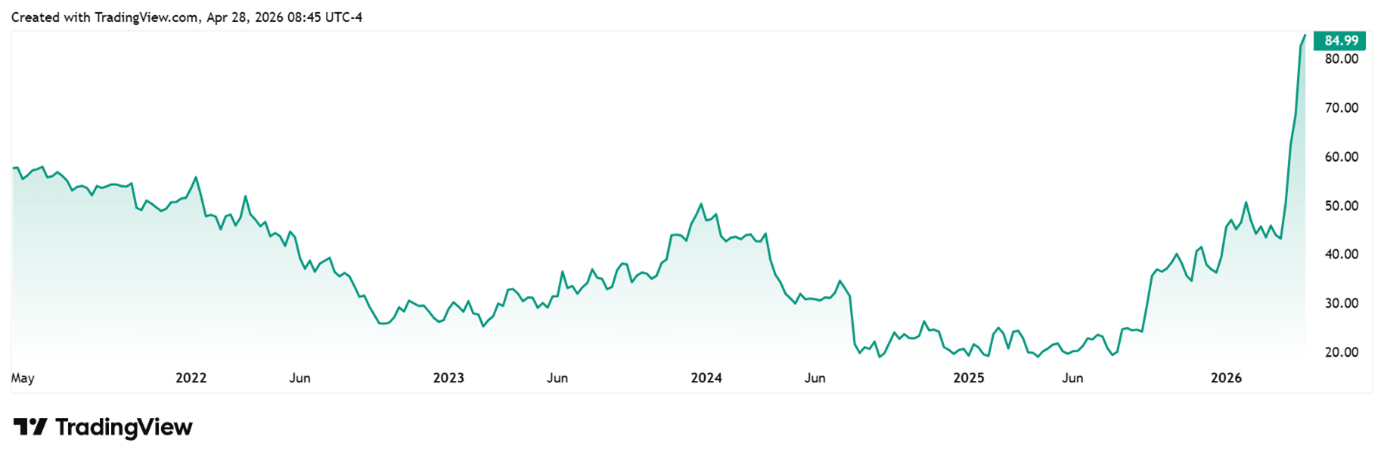
Intel’s stock price performance over the past five years*
The outlook was more important than the quarter itself
The most significant aspect of this report was not merely that Intel beat estimates in the first quarter, but rather that management presented investors with a more positive outlook for the coming period. It was precisely the unexpectedly strong revenue forecast that was the main catalyst for the sharp stock reaction and renewed confidence that the company could be entering a more favorable growth phase. This is crucial in Intel’s stock story because the market typically does not value the past for companies undergoing restructuring, but rather management’s ability to demonstrate that the coming quarters will be better than the previous ones.[3] [1]
AI demand appears to be shifting into the CPU segment as well
One of the most important takeaways from the results was that the AI boom is not only driving demand through specialized accelerators but is also beginning to boost demand for processors, a segment where Intel has historically held a strong position. Market optimism was bolstered by signs that the AI boom has reached the CPU segment as well, with CFO David Zinsner stating that the more favorable outlook was partly driven by this trend. If this shift is confirmed in the coming quarters, Intel would not only see one-time revenue growth but also a much stronger argument that its dominant position in traditional processors could once again be a strategic advantage in the AI cycle.[4] [2]
Intel pulled the entire semiconductor sector higher
The impact of this news wasn’t limited to a single stock, as U.S. chip stocks surged to record levels right after Intel injected new optimism into the market. At the time, the semiconductor sub-sector was on track for first-quarter earnings growth of 109.2%*, which was significantly higher than the S&P 500 index. This means that for a few days, Intel became not only the story of its own turnaround but also a catalyst for a broader belief that the AI investment cycle could have a deeper and more lasting impact on the entire chip manufacturing sector.4
The turnaround is not yet definitively confirmed
Despite the strong market reaction, it remains important to note that as recently as January, Intel was unable to fully meet demand for server chips used in AI data centers, and following a weaker outlook, the stock fell by 13%*. At the time, the company was grappling with the consequences of past product decisions and how quickly it could adapt production to the changing demand structure. That is precisely why today’s euphoria is significant, though it is not yet definitive proof that the turnaround is complete, as Intel will need to confirm in the coming quarters that the stronger outlook was not a one-off blip but the start of a more stable growth trend.[5] [3]
Conclusion
Intel is now at a point where its investment potential is no longer based solely on restructuring and is increasingly tied to whether it can translate AI demand into more sustainable growth in revenue, margins, and market confidence. It was precisely the unexpectedly strong outlook for the second quarter and signs of growing demand for CPUs in the AI environment that caused the stock to surge and put Intel back at the center of the semiconductor sector.
[1,2,3] Forward-looking statements are based on assumptions and current expectations that may prove to be inaccurate, or on the current economic environment, which may change. Such statements are not guarantees of future performance. They involve risks and other uncertainties that are difficult to predict. Actual results may differ materially from those expressed or implied in any forward-looking statements.
O.Z.I. Online Zone Investment Opportunities (OZIOS) is a registered trademark of APME FX TRADING EUROPE LTD, a Cyprus Investment Firm (CIF) supervised and regulated by the Cyprus Securities and Exchange Commission (CySEC) under CIF license number 335/17, with a registered address at Lophitis Business Center, Office 404, 4th Floor, 28 October Ave 249, Limassol 3035, Cyprus. Contracts for Difference (CFDs) are complex instruments and come with a high risk of losing money rapidly due to leverage. 76.44% of retail investor accounts lose money when trading CFDs with this provider. You should consider whether you understand how CFDs work and whether you can afford to take the high risk of losing your money.
* Past performance is not a guarantee of future results.
[1] https://en.wikipedia.org/wiki/Intel
[2] https://www.reuters.com/legal/transactional/intel-forecasts-second-quarter-revenue-above-estimates-2026-04-23/
[3] https://www.reuters.com/business/intel-set-record-high-ai-driven-cpu-demand-powers-upbeat-forecast-2026-04-24/
[4] https://www.reuters.com/business/us-chipmakers-hit-record-highs-intel-turbocharges-ai-rally-2026-04-24/
[5] https://www.reuters.com/business/intel-forecasts-first-quarter-sales-profit-below-estimates-2026-01-22/