Warning on risks: Financial contracts for difference are complex instruments and are associated with a high risk of rapid financial losses due to leverage. On 71.07% of retail investor accounts, financial losses occur when trading financial contracts for difference with this provider. You should consider whether you understand how financial contracts for difference work, and whether you can afford to take the high risk of suffering financial losses. Please read the Risk Disclosures.

Valero: Profit Rises More Than Sixfold, Refining Margins Soar
In the third quarter of 2026, Valero reported net income attributable to shareholders of $6.8 billion, more than six times last year’s result. The results, released on October 22, draw attention to an industry whose profitability is significantly influenced by trends in oil and fuel prices. The sharp growth was driven by strong refining margins and high-capacity utilization. Will the company be able to maintain this performance even after conditions in the fuel market change?
About the company
Valero Energy Corporation is a U.S. publicly traded company headquartered in San Antonio, Texas. Founded in 1980, it is engaged in oil refining, fuel production, and sales. It operates 14 refineries in the U.S., Canada, and the United Kingdom with a total refining capacity of approximately 3 million barrels per day. In addition, it owns 12 ethanol production plants and, through the Diamond Green Diesel joint venture, is also active in the renewable diesel and sustainable aviation fuel sectors. The company’s shares are traded on the New York Stock Exchange under the symbol VLO.[1]
Profits soared, but shares closed lower
In the third quarter of 2026, Valero reported net income attributable to shareholders of $6.828 billion, compared to $1.095 billion a year ago. Revenue rose from $32.168 billion to $46.098 billion, an increase of approximately 43.3%. Adjusted earnings per share rose from $3.66 to $23.90. The revenue growth was thus accompanied by an even more significant improvement in profitability. However, the market reaction was negative. On October 22, the company’s shares closed at $426.28, representing a daily decline of 2.4%.* Strong financial results alone were not enough to drive the stock price higher, and the sustainability of the company’s future performance remains a key factor in its valuation.[2][3]
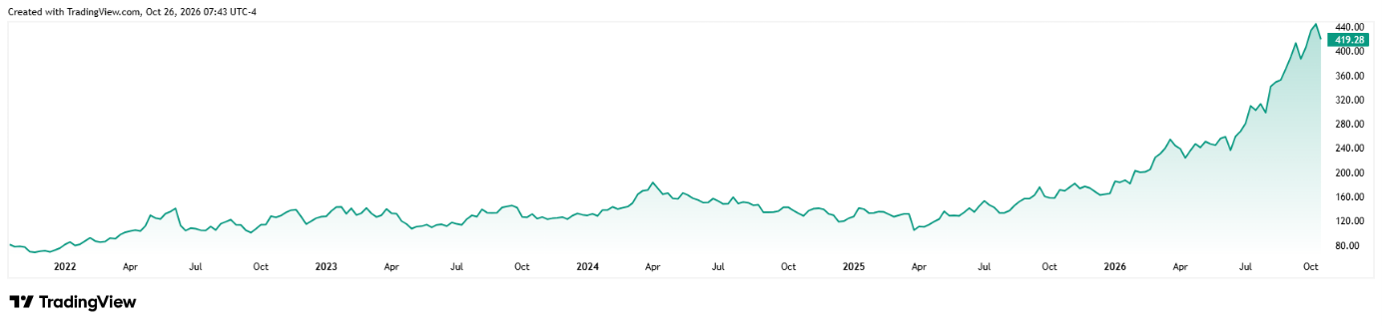
Valero’s Stock Price Performance Over the Past Five Years*
Refining margins have nearly tripled
Valero’s refining margin increased year-over-year from $13.14 to $39.24 per barrel of processed feedstock. This metric reflects the difference between the value of products sold and the cost of raw materials, before deducting other operating expenses. Profitability was bolstered by fuel supply disruptions related to the wars in Iran and Ukraine. Management also highlighted strong export demand for oil from Latin America and Europe. These conditions explain why the refining company can significantly increase its profits even when oil prices are higher. The key factor is the price trend of its inputs and finished products, and the current high margins cannot automatically be considered a permanent state.2[4]
Renewable fuels improved results
The improvement was also evident in renewable fuel production. The renewable diesel segment posted an operating profit of $353 million, compared with a loss of $28 million a year ago. Operating profit in the ethanol segment rose from $183 million to $272 million, and its production reached a record 4.8 million U.S. gallons per day. However, traditional refineries continued to generate the largest share of operating profit, contributing approximately $8.8 billion. The results therefore indicate a broader improvement in business performance, though the level of profitability across individual segments remains significantly different. When assessing future developments, it will be important to monitor each segment separately and evaluate what portion of the overall result it actually contributes.2
Cash flows support dividends and financial reserves
Operating activities generated approximately $6.9 billion for the company. Dividends to shareholders accounted for 52% of adjusted operating cash flow, which totaled $7.3 billion. As of the end of September, Valero had cash and cash equivalents of $9.8 billion, total debt of $8.6 billion, and additional finance lease obligations of $2.4 billion. During the quarter, it also repaid $526 million in bonds. Management has maintained its long-term cash target at $4 to $5 billion, citing the need for flexibility in a volatile market environment as the reason for the higher current cash reserve. The company’s cash allocation strategy thus balances shareholder returns with the maintenance of a financial reserve.[5]
Investments are primarily aimed at maintaining operations
Valero continues to expect capital expenditures of approximately $2 billion for 2026, of which about $1.7 billion is earmarked for maintaining operations. The budget includes repairs to a damaged unit at the Port Arthur refinery, with estimated costs of $250 million. The company expects these repairs to be completed by the end of the year, and a significant portion of the costs should be covered by insurance. For the fourth quarter, management anticipates cash operating costs for the refineries of approximately $4.85 per barrel. These plans thus emphasize the reliability and efficiency of existing operations. However, maintaining high profitability will depend on whether favorable refining margins persist despite changes in demand, feedstock prices, and fuel availability.5 [1]
Conclusion
Valero has had an exceptionally strong quarter, during which it converted high refining margins into $6.8 billion in profit attributable to shareholders. At the same time, improved results in renewable fuels and strong cash generation provide the company with room for investment, debt repayment, and shareholder returns. However, future performance will depend heavily on the development of refining margins, raw material prices, and fuel demand. It therefore remains crucial for investors to see how the company will leverage the current favorable period to strengthen its business. If Valero can control costs, maintain reliable production, and allocate capital prudently, it can improve its preparedness for less favorable conditions in the energy sector. [2]
* Past performance is no guarantee of future results.
[1,2] Forward-looking statements are based on assumptions and current expectations, which may be inaccurate, or on the current economic environment, which is subject to change. Such statements are not guarantees of future performance. They involve risks and other uncertainties that are difficult to predict. Actual results may differ materially from those expressed or implied in any forward-looking statements.
O.Z.I. Online Zone Investment Opportunities (OZIOS) is a registered trademark of APME FX TRADING EUROPE LTD, a Cyprus Investment Firm (CIF) supervised and regulated by the Cyprus Securities and Exchange Commission (CySEC) under CIF license number 335/17, with a registered address at Lophitis Business Center, Office 404, 4th Floor, 28 October Ave 249, Limassol 3035, Cyprus. Contracts for difference (CFDs) are complex instruments and carry a high risk of rapid financial loss due to leverage. 77.44% of retail investor accounts lose money when trading CFDs with this provider. You should consider whether you understand how CFDs work and whether you can afford to take the high risk of losing your money.
[1] https://www.valero.com/about
[2] https://investorvalero.com/news/news-details/2026/Valero-Energy-Reports-Third-Quarter-2026-Results/default.aspx
[3] https://www.marketwatch.com/data-news/valero-energy-corp-stock-underperforms-thursday-when-compared-to-competitors-5c784544-e0ff29b7892b
[4] https://www.reuters.com/business/energy/valero-kicks-off-refiner-results-with-record-quarterly-profit-higher-margins-2026-10-22/
[5] https://stockanalysis.com/stocks/vlo/transcripts/719976-q3-2026/