Kockázati figyelmeztetés: A pénzügyi különbözeti ügyletek (CFD-k) összetett eszközök, és a tőkeáttétel miatt magas kockázattal járnak, ami gyors pénzügyi veszteségekhez vezethet. Ennél a szolgáltatónál a lakossági befektetői számlák 77.44%-án pénzügyi veszteség keletkezik CFD-kereskedés során. Fontolja meg, hogy megérti-e, hogyan működnek a CFD-k, és hogy megengedheti-e magának a magas pénzügyi veszteség kockázatát. Kérjük, olvassa el a Kockázati Tájékoztatót.

TSMC: Profit rose by nearly 69%; the chip giant expects further growth
TSMC’s latest results may offer significant insights into the future of investments in artificial intelligence. Investors are focusing not only on the financial results themselves but also on what the company has hinted at for the coming year. It is precisely the management’s statements that give the published figures a new dimension. Will the Taiwanese chipmaker be able to maintain the pace of growth to which the market has become accustomed?
About the company
Taiwan Semiconductor Manufacturing Company, known as TSMC, is a Taiwanese publicly traded company headquartered in Hsinchu. Founded in 1987 by Morris Chang, it specializes in manufacturing semiconductors based on its customers’ designs. Its chips are used in smartphones, high-performance computing systems, automobiles, and other electronic devices. In 2025, it manufactured 12,682 different products for 534 customers using 305 manufacturing technologies. Its American depositary shares are traded on the New York Stock Exchange under the symbol TSM.
Profit jumped by nearly 69%
In the third quarter of 2026, TSMC reported revenue of $46.72 billion, representing year-over-year growth of 41.2% in dollar terms. Net income increased by 68.7% to NT$763.06 billion and rose by 8% compared to the previous quarter. Diluted earnings per common share reached NT$29.43. The exceptionally strong profitability is confirmed by a net margin of 51.1%. For every NT$100 in revenue, the company generated approximately NT$51 in net income. The results, released on October 15, show that strong demand for state-of-the-art manufacturing technologies is translating into concrete financial results and providing the company with room for further large-scale investments.
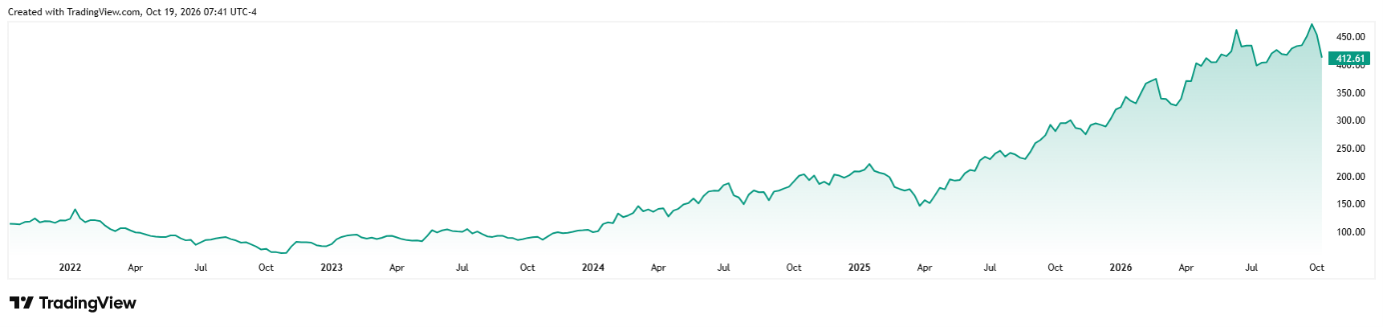
TSMC’s Stock Price Performance Over the Past Five Years*
Computing chips are reshaping the business landscape
The high-performance computing segment already accounted for 68% of TSMC’s total revenue, up from 57% a year ago. Its revenue increased by 22% compared to the previous quarter. This category encompasses a broader range of computing chip applications, so its share cannot automatically be equated with the share of artificial intelligence alone in the company’s revenue. Smartphones accounted for 21% of total revenue, down from 30% a year ago, although their revenue grew by 10% quarter-over-quarter. At the same time, the importance of state-of-the-art manufacturing processes is growing. 2-nm technology already accounted for 8% of revenue from chip sales, and 3-nm technology for another 33%. The results thus indicate the company’s growing dependence on advanced chips and investments in computing infrastructure.2
Plans to invest tens of billions to expand capacity
The company has maintained its capital expenditure plan for 2026 in the range of $60 to $64 billion. Management also expects that total investments for 2026 through 2028 will significantly exceed expenditures from the previous three years. The expansion includes nearly 20 facilities, including advanced chip packaging operations. According to the company’s expectations, production capacity for 2-nm technology is set to more than double in 2027, with demand coming from both smartphones and computing applications. In Arizona, TSMC plans to begin mass production at its second plant in the third quarter of 2027. The scale of these projects demonstrates management’s confidence in long-term growth, but it also heightens the importance of proper production timing and sufficient utilization of new capacity. [1]
Margins fell, free cash flow rose significantly
Despite profit growth, the gross margin decreased from 67.7% to 66.4% compared to the previous quarter, and the operating margin fell from 60.3% to 58.7%. However, cash flow remained strong. Operating activities generated NT$919.77 billion, while capital expenditures totaled NT$443.21 billion. After deducting capital expenditures, free cash flow amounted to NT$476.56 billion, more than triple the figure for the same period a year ago. Cash and marketable securities at the end of September totaled approximately NT$4.02 trillion. These figures indicate that the company is capable of generating significant financial resources even during a period of investment expansion, although high margins may not increase every quarter.2
A strong outlook is accompanied by caution ahead of 2027
For the fourth quarter, TSMC expects revenue in the range of $52.3 billion to $54.3 billion. According to management, full-year revenue growth in dollar terms is expected to reach approximately 44%. Despite strong demand for state-of-the-art chips, the company is taking a cautious approach to planning for 2027. CEO C. C. Wei highlighted rising component prices and economic uncertainty, which are weighing particularly heavily on consumer and price-sensitive segments. It therefore remains important for investors to monitor whether the continued growth in demand for AI chips will translate into further profit growth, even amid higher costs and extensive investments.2 [2]
Conclusion
TSMC is entering the end of the year with strong results, the growing importance of computing chips, and extensive investment plans. The 68.7% year-over-year increase in net income confirms that demand for state-of-the-art manufacturing technologies is delivering tangible financial results for the company. At the same time, the planned investments of $60 to $64 billion demonstrate the significant opportunities management sees in the coming years. However, the cautious approach to planning for 2027 highlights the importance of rising costs and economic uncertainty. If the company can effectively utilize new capacity, maintain its technological edge, and control costs, the continued development of artificial intelligence could support its further growth and strengthen its position in the global semiconductor industry. [3]
* Past performance is no guarantee of future results.
[1,2,3] Forward-looking statements are based on assumptions and current expectations, which may be inaccurate, or on the current economic environment, which is subject to change. Such statements are not guarantees of future performance. They involve risks and other uncertainties that are difficult to predict. Actual results may differ materially from those expressed or implied in any forward-looking statements.
O.Z.I. Online Zone Investment Opportunities (OZIOS) is a registered trademark of APME FX TRADING EUROPE LTD, a Cyprus Investment Firm (CIF) supervised and regulated by the Cyprus Securities and Exchange Commission (CySEC) under CIF license number 335/17, with a registered address at Lophitis Business Center, Office 404, 4th Floor, 28 October Ave 249, Limassol 3035, Cyprus. Contracts for Difference (CFDs) are complex instruments and carry a high risk of rapid financial loss due to leverage. 77.44% of retail investor accounts lose money when trading CFDs with this provider. You should consider whether you understand how CFDs work and whether you can afford to take the high risk of losing your money.